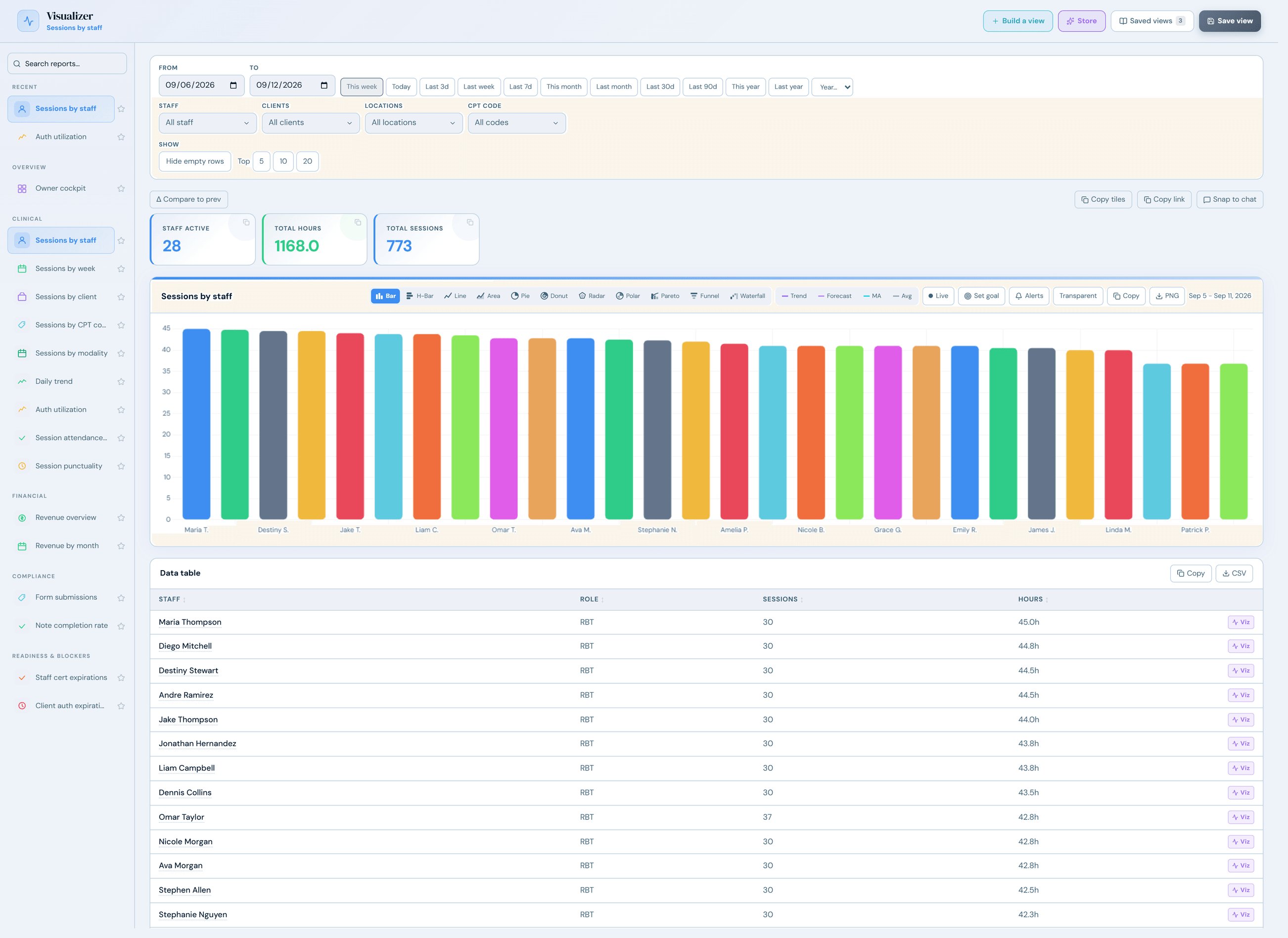
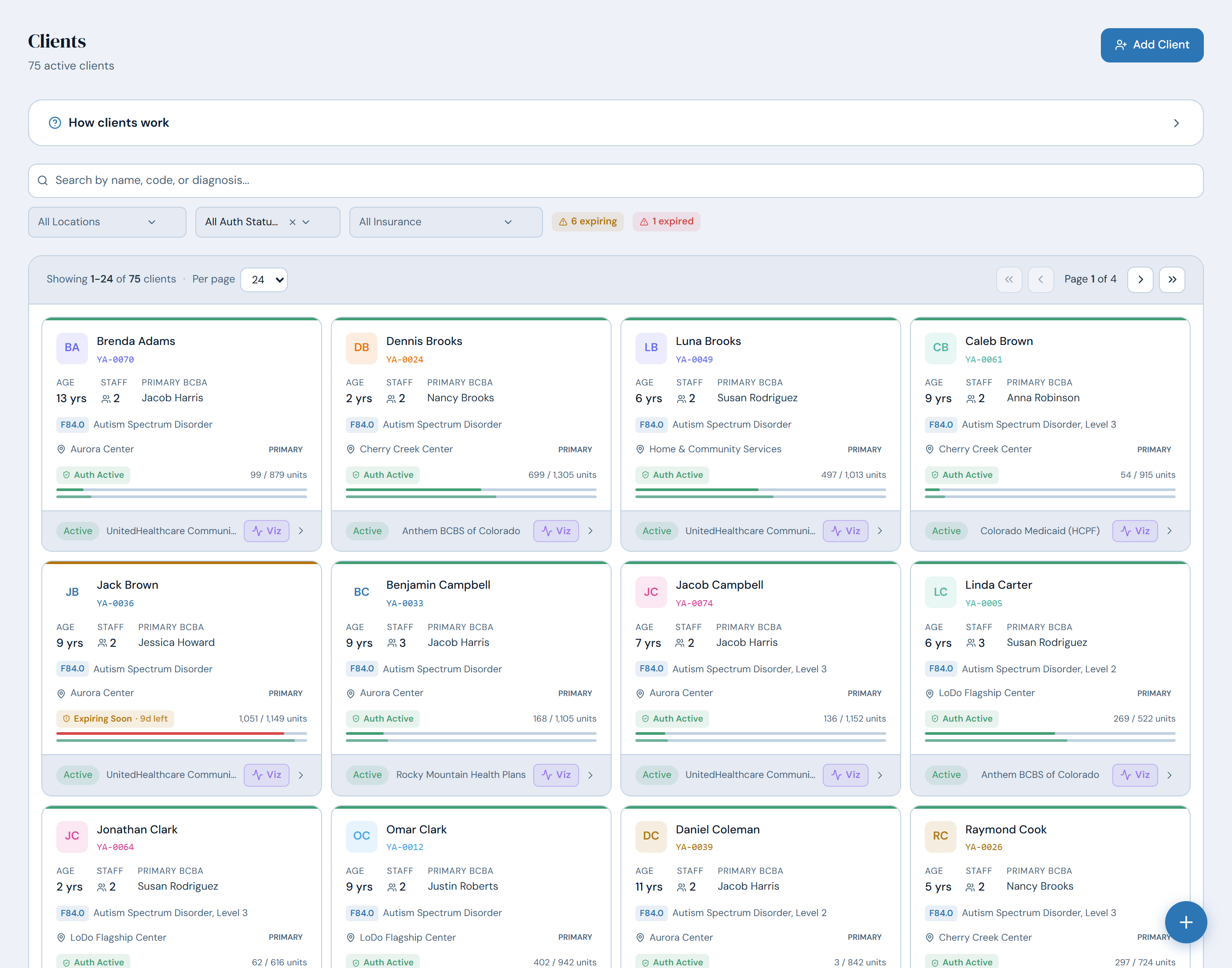
Your RBTs collect data on a phone with no signal. That data becomes the note your BCBA signs, the claim your biller sends, and the hours your payroll run pays out. It is one database, so nobody re-types anything. ABAVault™ replaces the three platforms you pay for today and the week your team loses carrying data between them.
Apply for beta access Take the interactive tourMost practices stitch together a clinical tool, a billing system, and HR spreadsheets. ABAVault was built as one system from day one.
Every data type a BCBA actually uses, from DTT with prompt hierarchies through interval recording and ABC. RBTs collect on mobile with no signal and it syncs when they are back in range. Graphs come out of the review with phase lines and mastery thresholds already drawn, so nobody screenshots anything.
The session your team verified becomes the claim your biller submits. 837P files and CMS-1500 forms generate themselves, go out through an integrated clearinghouse, and ERAs post back on their own. Eligibility is checked before care happens, and payer rules catch a wrong modifier while it is still cheap to fix.
A real accrual ledger with tenure tiers and carryover caps. Credential expirations that alert while there is still time to renew. A payroll export computed from GPS-verified hours under your state's labor rules. Everywhere else this lives in a spreadsheet and a second subscription, which is why your ops manager runs it on Sunday.
The scheduler matches staff availability against client authorizations and location hours, and flags conflicts before they reach the calendar. GPS clock-in confirms the session happened where it was supposed to.
Families see upcoming sessions and the progress summaries your BCBA chooses to share. They sign consents, message the team, and pay balances by card. Your BCBAs decide what is visible.
Session notes and progress summaries drafted from the trials and durations your team actually recorded. A clinician reviews and signs every one, and every call is audit-logged. How that works.
These are not nicer versions of features everyone already has. They only become possible once clinical, billing, and HR sit on one database.
Every accrual, request, and adjustment is a dated ledger entry, so a balance can be defended line by line. Approve a day off and the sessions needing coverage light up immediately. The payroll export picks up the paid hours on its own.
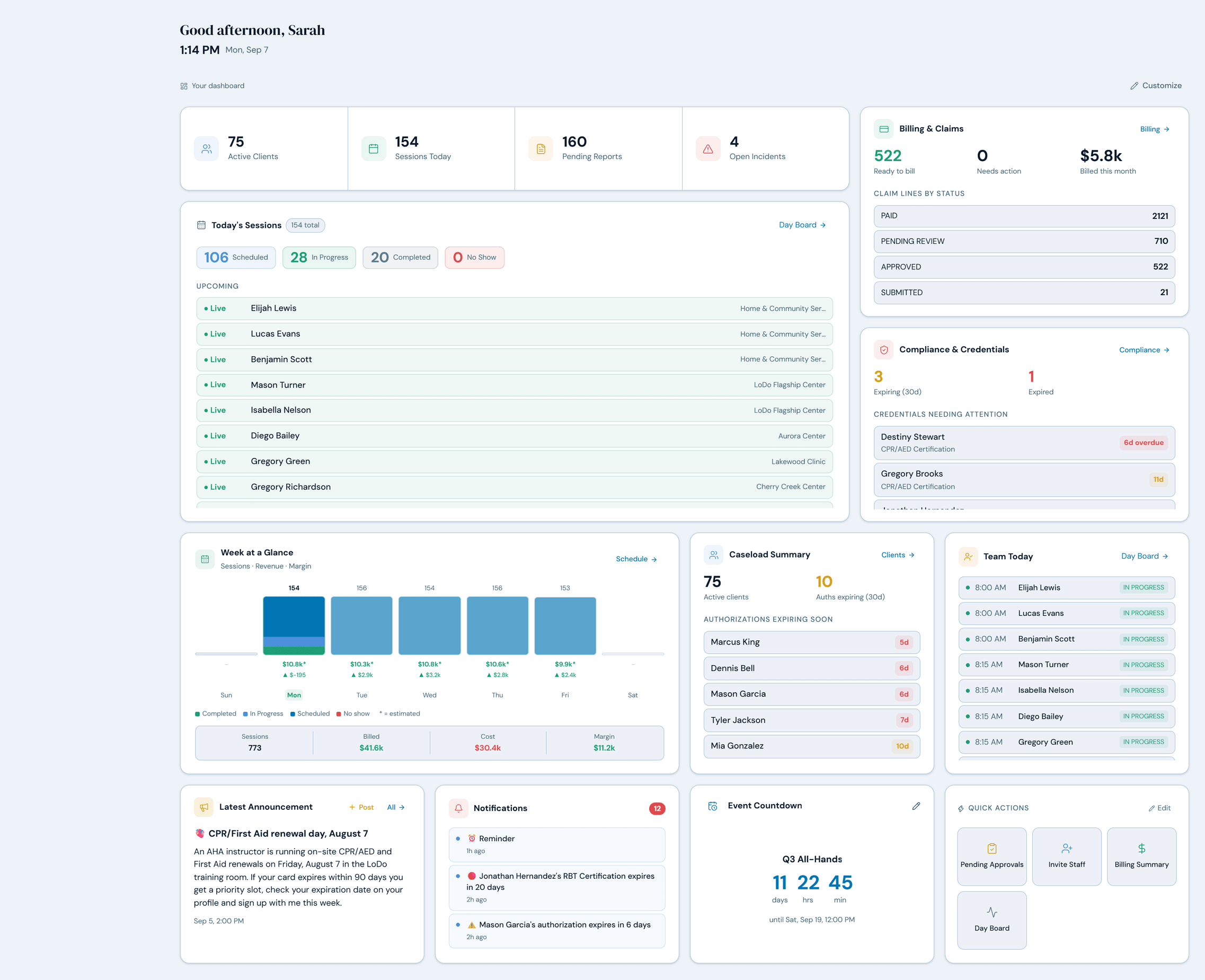
Every billing code on the booking form shows how many authorized units are left, and the bar turns amber when the authorization is running low. A pace score flags authorizations burning too slowly while there is still time to use the units, and ones burning too fast before they run out.
Delivered sessions with no billable line. Coverage that quietly lapsed. Authorizations depleting off pace. All of it surfaces on the dashboard daily, while most practices are still finding these at month-end close. Recover one session per client per quarter and the tool has paid for the platform; run your own numbers in the checkup.
Staff clock in and out on their phone with location verification, and travel and mileage are captured per session. Those exact hours flow into the payroll export with overtime computed under your state's labor rules. The Thursday night ritual of squinting at three tabs to build a pay run goes away.
Basement sessions, rural drives, a school with concrete walls. Collection keeps working, queues on the device, and syncs with the original timestamps when signal comes back. The sync is idempotent, so a replayed upload cannot write the same session twice. Plenty of apps claim offline. Ask how they handle a double replay.
Patient-responsibility balances appear in the caregiver portal, families pay by card, and the payment posts to the client ledger on its own. That removes the mailed statement, the front-desk conversation, and a separate merchant reconciliation at month end.
Modeled on a 40-client, 40-staff practice running three separate systems today. Your practice will look different, which is why the 2-Minute Practice Checkup exists to estimate your own.
| Who | The weekly grind today | Typical hours now | On ABAVault |
|---|---|---|---|
| Owner / ops | Payroll reconciliation across systems, PTO spreadsheet upkeep, chasing unbilled sessions | 6-10 hrs | Under 2 hrs |
| Scheduler | Building the calendar by hand against availability, auths, and locations | 6-8 hrs | 1-2 hrs of review |
| Biller | Assembling claims from session records, hunting statuses across payer portals | 8-12 hrs | 2-3 hrs of exceptions |
| Each BCBA | Reconstructing session notes, assembling graphs for reviews | 4-6 hrs | About 1 hr of review-and-sign |
At a loaded admin cost of $32 per hour, twenty recovered hours a week is roughly $33,000 a year before counting a single prevented denial. Estimates for comparison; run your own in the checkup.
Every ABA platform's website looks confident. Fewer of them show you the software. These are captures from a running demo tenant, unretouched.
A BCBA owner-operator running 20 to 150 clients across a few locations should not need an enterprise contract, a six-month implementation, or a full seat licence for every RBT they hire. ABAVault is in beta right now, which means the platform is free while we work out what it should cost, and nobody sees a bill without 30 days written notice first.
Eight questions and about two minutes, for an itemized estimate of the hours and dollars your current systems leak each week. Every formula is shown, so bring your skepticism.
SECURITYTenant isolation on every query, 17 permission roles, audit logs, MFA, and AI that drafts but never signs. Bring your compliance officer.